The International Cricket Council (ICC) is preparing to introduce a series of significant rule changes across all three formats of international cricket. Among the most discussed proposals is a plan that could allow the use of a pink ball during a traditional red-ball Test match if poor lighting conditions interrupt play.
The proposed change is aimed at reducing unnecessary stoppages during Test matches, especially in venues where fading natural light makes the red ball difficult to see under floodlights.
ICC Exploring Pink Ball Option During Poor Light
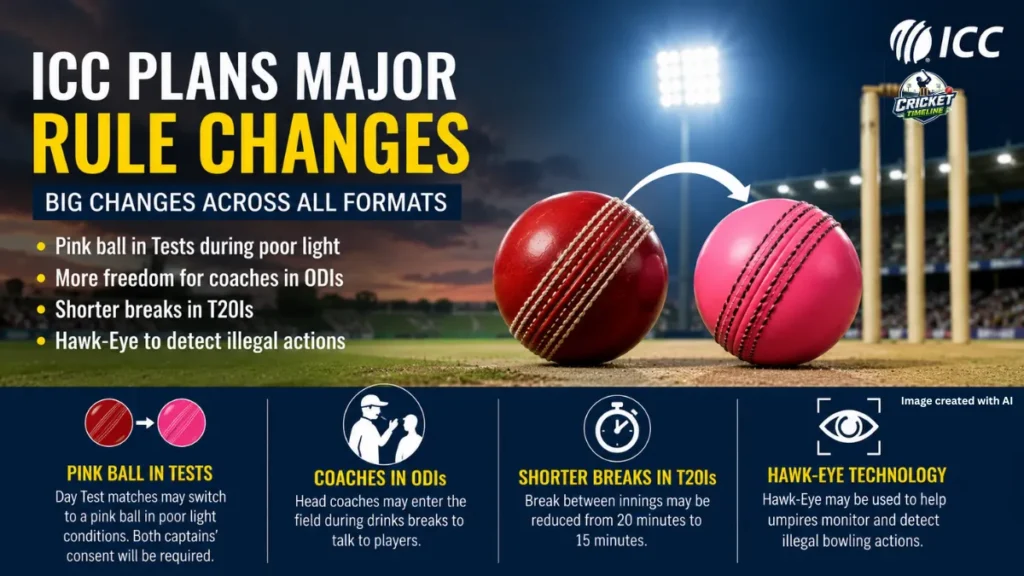
Under the proposal, a Test match that begins with the traditional red ball could temporarily switch to a pink ball if umpires decide that visibility has become unsafe or unsuitable because of bad light. The pink ball is considered easier to spot under artificial lighting, which could help matches continue without long interruptions.
However, the rule would not apply automatically. Both team captains would need to agree before the ball is changed during the match. The proposal is designed specifically for regular daytime Test matches played at grounds equipped with floodlights.
Day-night Test matches would remain unchanged, as they are already played entirely with a pink ball.
The move reflects ICC’s effort to modernize Test cricket while preserving the format’s traditional structure. Poor light has often been a frustrating issue for players, broadcasters, and fans, particularly when overs are lost late in the day despite playable conditions.
Proposal Discussed in ICC Executive Meeting
According to reports, the suggested changes were presented during a virtual meeting of the ICC Chief Executives’ Committee (CEC) held on Thursday. Former India captain Sourav Ganguly, who currently heads the ICC Cricket Committee, also attended the discussion.
The proposals are expected to be reviewed further at the ICC Board meeting scheduled to take place in Ahmedabad on May 30. If approved, the new playing conditions could officially come into effect from October 1.
Coaches May Get More Freedom in One-Day Internationals
The ICC is also considering changes to communication rules during One-Day Internationals (ODIs).
At present, only substitute players carrying drinks are allowed onto the field during official drinks breaks, and they must be dressed in full cricket whites or team kit. The new proposal would allow head coaches to enter the field during drinks intervals and speak directly with players.
This rule is already permitted in T20 Internationals, where coaches are allowed limited on-field interaction with teams during breaks. Extending the same flexibility to ODIs could improve tactical communication during matches.
Shorter Breaks Could Speed Up T20 Matches
Another important proposal focuses on reducing the interval between innings in T20 Internationals.
Currently, teams receive a 20-minute break between innings. The ICC is considering cutting that break to 15 minutes in an effort to shorten overall match duration and make broadcasting schedules more efficient.
With T20 cricket continuing to attract global audiences, administrators are looking for ways to keep matches fast-paced and viewer-friendly without affecting the quality of play.
Also read: IPL Social Media Ban: BCCI Introduces Strict Rules on Reels, Videos and Online Posts During Matches
Hawk-Eye Technology Could Help Detect Illegal Bowling Actions
The ICC is also exploring the use of Hawk-Eye technology to assist on-field umpires in identifying suspicious bowling actions during matches.
If implemented, the technology could provide additional support in monitoring whether bowlers are exceeding the legal elbow extension limit. Illegal bowling actions have remained a sensitive issue in international cricket for years, and the use of advanced tracking systems may help improve consistency and accuracy in decision-making.
The latest proposals suggest that the ICC is actively looking for ways to balance tradition with technology while improving the experience for players, officials, broadcasters, and fans across the game.